Wednesday, April 28, 2010
Dr. Harlow's Rhesus Monkeys
This video with the monkeys is critical to motor development. It shows how the monkeys like human are drawn to the soft mother rather than the wire monkey. The only reason the baby monkey went to the wire monkey was for nourishment. As soon as the monkeys finished eating they would return to the soft mother. This had a devastating affect on the monkeys socially, they were not able to interact later in life. They were scared and confused. This is just one more reason to love your children.


Thursday, April 15, 2010
To Infinity and Beyond


Tuesday, April 6, 2010
Thank You Easter Bunny!!
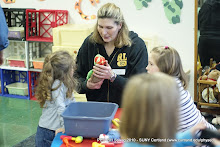
It was an Easter theme this week. We observed throwing and catching activities this week. The boy that we observed picked up the ball with his right hand first. and threw it. Then he picked a ball up with his left hand and threw it. He threw with both hands pretty well but, his right hand was the more dominant one. Neither the boy nor the girl we observed this week rotated their hip and shoulders, or transfer weight by stepping with the opposite foot. Both could perform all the criteria for catching. This week was a lot of fun. The kids really enjoyed all the bunny ears and the props. It really makes you feel good when the kids really enjoy the activities that were planned for the lab.


Wednesday, March 10, 2010
Dinosaurs, Trains and Fun
Jen did a great obstacle course tonight! She put a lot of work into it. I wish I had more artistic talent. I think that is an area that I need to work on. The kids liked the game that she designed for them. The activity captivated the kids. Blaze was scheduled to make an appearance tonight, but couldn't make it and the kids didn't really seam to mind. I played with a jump rope group tonight, and it brought back some fond memories. I hope that the kids of St. Mary's have the same fond memories that I have.
Tuesday, March 9, 2010
Motor Development Prezi
The Prezi is an exciting tool. Its learning curve is just as steep as all over technologies. Once you get going, it work surprisingly well. It doesn't matter how big each of your frames are, they will re-size and adjust as the presentation is run live. Images are embedded though uploading the file to your Prezi.
Check out my first Prezi: Motor Development
Check out my first Prezi: Motor Development
Tuesday, March 2, 2010
Big Issues in the US
Jacqueline Graves
PED 201 SP10
The three critical issues facing children in the US today are, childhood obesity, in-school and community violence, and early onset of puberty. The physically educated person should be identified as someone who is physically fit, participates in regularly physical activity, knows the implications and the benefits of involvement in physical activities and values and contributes to a healthy lifestyle.
Three factors that explain the relationships that lead to the development of the whole child are biology of the individual, conditions of the learning environment and requirements of the movement task. Individual appropriateness is based each child being unique. They will differ in timing, pattern of growth, and development. Age-group appropriateness is based on a curriculum and not on chronological age or grade; however both influence age-group appropriateness.
Three fundamental locomotor movements are walking, running, and leaping. Three fundamental manipulation movements include volleying, punting and kicking. Axial movements are movements that are non-locomotor movements such as bending twisting or turning. Some examples of static/dynamic movements are stopping, dodging, and rolling.
Physical fitness is defined as a combination of health-related and performance-related components. Health-related fitness includes muscular strength, muscular endurance cardiovascular endurance joint flexibility and body composition. Performance-related fitness includes balance, coordination, agility, speed and power.

PED 201 SP10
The three critical issues facing children in the US today are, childhood obesity, in-school and community violence, and early onset of puberty. The physically educated person should be identified as someone who is physically fit, participates in regularly physical activity, knows the implications and the benefits of involvement in physical activities and values and contributes to a healthy lifestyle.
Three factors that explain the relationships that lead to the development of the whole child are biology of the individual, conditions of the learning environment and requirements of the movement task. Individual appropriateness is based each child being unique. They will differ in timing, pattern of growth, and development. Age-group appropriateness is based on a curriculum and not on chronological age or grade; however both influence age-group appropriateness.
Three fundamental locomotor movements are walking, running, and leaping. Three fundamental manipulation movements include volleying, punting and kicking. Axial movements are movements that are non-locomotor movements such as bending twisting or turning. Some examples of static/dynamic movements are stopping, dodging, and rolling.
Physical fitness is defined as a combination of health-related and performance-related components. Health-related fitness includes muscular strength, muscular endurance cardiovascular endurance joint flexibility and body composition. Performance-related fitness includes balance, coordination, agility, speed and power.
Michelle Obama Tackles Childhood Obesity

Thursday, February 25, 2010
Winter Olympics Go for the Gold!
Working with the preschoolers was fun. They were very energetic. In all activities, all the children, but one did not want to participate. We heard that some kids were singing the alligator song at dinner time, with their family. They talked about the arts and crafts that we prepared for them. They were excited and this in turn made me excited to teach them.
Subscribe to:
Posts (Atom)